

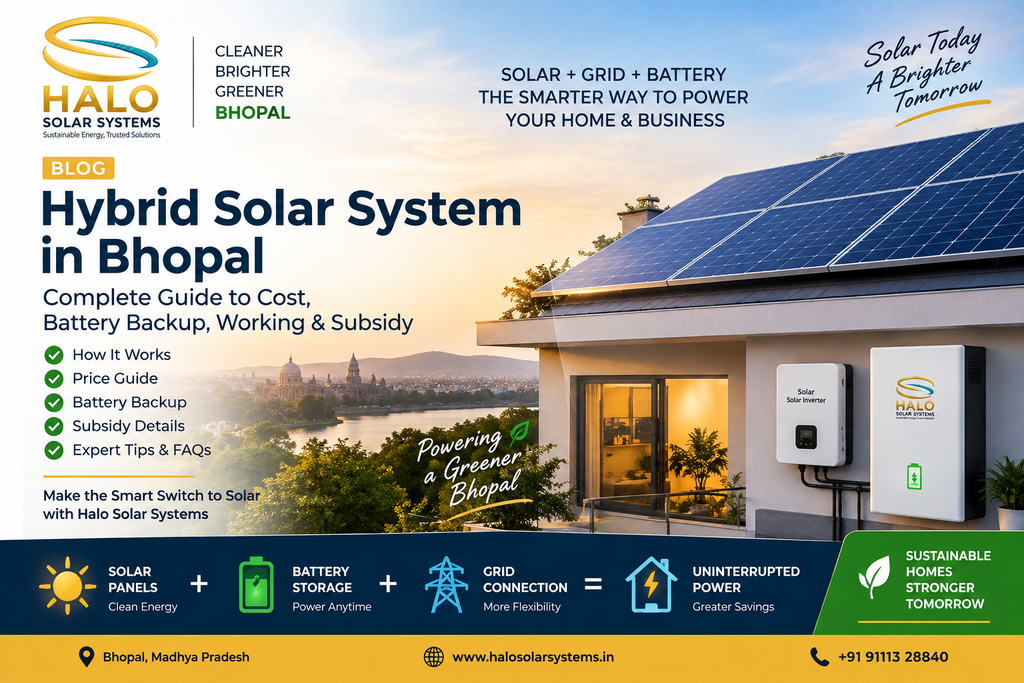
Electricity needs are changing. Many homeowners no longer want a rooftop solar system only to reduce daytime grid consumption—they also want backup power when electricity is unavailable.
That is where a hybrid solar system becomes useful.
A hybrid solar system combines solar panels, a hybrid inverter, battery storage and grid connectivity within one energy system. During sunny hours, solar energy can supply household loads and, depending on system design and operating settings, charge the battery. Grid-connected configurations may also manage surplus generation according to the applicable metering arrangement. When solar generation is insufficient, stored battery energy and/or grid electricity can support the connected loads.
For homeowners considering a hybrid solar system in Bhopal, however, the important question isn’t simply “Should I install solar?” The better questions are:
How much electricity do I consume? Which appliances need backup? How long should the backup last? How much usable roof space is available? And is a hybrid system actually more suitable than an on-grid system for my home?
This guide explains those questions in practical terms.
What Is a Hybrid Solar System?
A hybrid solar system is a solar power setup designed to work with more than one energy source.
A typical residential configuration can include:
Solar panels → Hybrid inverter → Home loads → Battery storage → Electricity grid
The solar panels generate DC electricity from sunlight. The inverter manages conversion and power flow between the solar array, household electrical loads, battery and grid according to the system configuration.
This gives a hybrid system one major difference from a conventional grid-connected rooftop solar system: energy storage can be incorporated for selected backup requirements.
Halo Solar Systems’ current hybrid system page similarly describes its configuration around solar panels, grid connectivity and battery backup.
How Does a Hybrid Solar System Work During the Day?
Imagine a Bhopal home where the rooftop solar array is generating electricity at midday.
Solar generation can first be used for the home’s active electrical loads, depending on how the system has been configured. Available solar energy may then be used for battery charging, while grid import/export is managed according to the inverter configuration and applicable DISCOM/net-metering arrangement.
The exact priority—solar, battery or grid—is not identical for every installation. It depends on the inverter, battery settings, permitted grid arrangement and how the system has been commissioned.
This is why hybrid solar should be designed around the household rather than sold as a standard package.
What Happens at Night?
Solar panels do not generate electricity at night.
At that point, the home’s electricity can come from the battery and/or electricity grid, depending on battery state of charge, inverter settings and which loads are connected to backup.
This is one reason people searching for a solar system with battery backup in Bhopal may consider hybrid solar instead of a conventional on-grid-only configuration.
But battery capacity matters enormously.
A small battery designed to support lights, fans, Wi-Fi and selected electronics is very different from a system expected to support air conditioners, pumps, geysers and other high-load appliances.
What Happens During a Power Cut?
This is one of the most important differences homeowners should understand.
A standard grid-tied solar inverter generally shuts down during a grid outage as an anti-islanding safety measure. Therefore, having solar panels on your roof does not automatically mean your home will continue receiving solar electricity during a power cut.
A correctly designed hybrid system can provide backup to designated loads through its battery/backup arrangement, subject to inverter capacity, battery capacity, system configuration and installation design.
So don’t ask only:
“How many kW solar should I install?”
Also ask:
“Which appliances do I want to operate during a power cut, and for approximately how long?”
That question often determines the battery requirement.
Hybrid Solar vs On-Grid Solar: Which Is Better?
There is no universal winner. They solve different requirements.
| Factor | On-Grid Solar | Hybrid Solar |
|---|---|---|
| Solar panels | Yes | Yes |
| Grid connected | Yes | Yes |
| Battery | Usually no | Yes / configurable |
| Backup capability | Normally no during outage | Can provide backup when correctly designed |
| Initial investment | Generally lower | Generally higher |
| Battery management | No | Yes |
| Suitable for | Savings-focused grid-connected users | Users wanting solar + storage/backup |
If your primary objective is reducing electricity purchased from the grid and your electricity supply is reasonably reliable, an on-grid solar system in Bhopal may be worth evaluating first.
If backup is also important, a hybrid solar system with battery storage may be more appropriate.
How Many kW Hybrid Solar System Does a Home Need?
Avoid choosing capacity simply because someone tells you that “3kW is standard.”
System sizing should consider:
- Recent electricity bills and monthly unit consumption
- Daytime versus nighttime consumption
- Available shadow-free roof area
- Sanctioned electrical load and connection
- Backup appliances
- Desired backup duration
- Future loads such as an EV or additional air conditioners
- Battery capacity
- Applicable DISCOM requirements
For example, two households with the same electricity bill may require different systems if one uses most electricity during daylight hours while the other consumes heavily at night.
3kW Hybrid Solar System
A 3kW hybrid solar system may be considered for some residential properties with moderate electricity requirements, but suitability depends on the home’s actual consumption and backup requirement.
Don’t assume that a 3kW solar array automatically requires a particular battery capacity.
Solar capacity and battery capacity solve different problems.
Solar capacity primarily relates to energy generation. Battery capacity relates to how much energy needs to be stored and subsequently supplied.
5kW Hybrid Solar System
A 5kW hybrid solar system in Bhopal may be considered where electricity consumption and suitable rooftop area justify a larger system.
Again, the correct size should follow a site and load assessment rather than a generic package.
How Much Battery Does a Hybrid Solar System Need?
This is one of the best questions to answer before asking the price.
Suppose you want backup for:
4 fans + 6 lights + Wi-Fi router + television.
That requirement is completely different from wanting:
2 air conditioners + refrigerator + water pump + lights + fans.
Battery sizing should consider the approximate load in watts, expected backup duration, battery chemistry, usable depth of discharge, inverter efficiency and system design.
A simplified conceptual calculation is:
Required stored energy ≈ Backup Load × Required Backup Hours
Real battery sizing then needs appropriate allowances for system losses, usable battery capacity and operating limits.
Example
If selected backup loads total approximately 800 watts and you want roughly 4 hours of backup:
800 W × 4 hours = 3.2 kWh
That does not automatically mean buying a 3.2 kWh battery. Actual required nominal capacity can be higher depending on usable depth of discharge, inverter losses, battery characteristics and reserve settings.
Have the load calculated properly before selecting a battery.
Lithium Battery vs Lead-Acid Battery for Hybrid Solar
Battery choice influences system cost, usable storage, maintenance and long-term operation.
Lithium-based batteries—particularly appropriate Li-ion/LFP products—can offer higher usable depth of discharge, compact size and lower routine maintenance compared with traditional lead-acid configurations, but they generally involve a higher upfront investment.
Lead-acid battery systems may have a lower initial cost in some configurations, but maintenance requirements, usable discharge limits, space and replacement considerations should be evaluated.
Halo Solar Systems’ existing hybrid page currently lists Li-ion/LFP battery options from 4.8–10 kWh as part of its system configuration.
The correct choice should depend on expected cycling, backup requirement, inverter compatibility, installation environment, budget and warranty terms.
Hybrid Solar System Price in Bhopal: What Determines the Cost?
There is no responsible single price for every hybrid solar system in Bhopal because a hybrid system has more variables than a basic rooftop solar installation.
Price can change according to:
1. Solar capacity: 2kW, 3kW, 5kW or larger.
2. Solar panel technology: module wattage, technology and manufacturer.
3. Hybrid inverter: capacity, MPPT configuration, battery compatibility and backup functionality.
4. Battery storage: battery chemistry and usable kWh capacity can substantially affect project cost.
5. Mounting structure: roof type, elevation, structural requirement and site conditions.
6. Electrical/BOS components: protection equipment, cables, earthing and other balance-of-system requirements.
7. Installation complexity: cable routes, roof access, distribution-board modifications and other site-specific work.
For this reason, homeowners comparing hybrid solar system prices in Bhopal should compare complete system specifications—not just the final quotation.
A lower quotation with a much smaller battery cannot be fairly compared with a higher quotation containing significantly more usable storage.
Is PM Surya Ghar Subsidy Available for a Hybrid Solar System?
This needs careful wording.
Under PM Surya Ghar: Muft Bijli Yojana, Central Financial Assistance is aimed at eligible residential grid-connected rooftop solar installations. The scheme’s CFA structure provides support for the first 3 kW, with no additional CFA beyond 3 kW. Official scheme information has described the support as ₹30,000/kW for the first 2 kW and ₹18,000 for the additional third kW, making the commonly referenced maximum central subsidy ₹78,000 for eligible residential installations of 3 kW or more.
However, homeowners should not assume that the battery portion of a hybrid system is subsidised simply because the installation contains rooftop solar. Eligibility depends on the qualifying grid-connected rooftop solar plant, scheme requirements, technical specifications, application process and DISCOM verification. Official guidelines define an eligible residential RTS plant for CFA purposes as a grid-connected solar system tied to a residential electricity connection.
Therefore, before publishing a quotation saying “₹78,000 subsidy on hybrid solar,” verify the customer’s proposed configuration and current eligibility.
PM Surya Ghar official information
Does a Hybrid Solar System Work With Net Metering in Bhopal?
A grid-connected hybrid installation may interact with the grid under the applicable metering and DISCOM framework, but net-metering eligibility and technical requirements should be verified for the proposed system configuration before installation.
Don’t assume that every inverter, battery arrangement or system architecture automatically qualifies.
For a rooftop project in Bhopal, check the current requirements applicable through the relevant Madhya Pradesh electricity distribution utility and the PM Surya Ghar process where applicable.
What Roof Conditions Are Suitable for Hybrid Solar in Bhopal?
Before installing panels, examine more than the total roof area.
A solar site assessment should consider:
Shadow: Nearby buildings, water tanks, trees, parapet walls and other objects can affect generation.
Orientation and layout: Panels should be positioned according to site conditions and solar exposure.
Structural condition: The roof and mounting arrangement must be appropriate for the proposed system.
Maintenance access: Panels should remain accessible for inspection and cleaning.
Future construction: Don’t place an array where a planned additional floor, water tank or other structure will later create shading or require relocation.
Bhopal’s climate also makes dust and seasonal weather part of the maintenance discussion. Halo’s current service page specifically positions its system design around Madhya Pradesh’s local heat, dust, grid and policy conditions.
Is a Hybrid Solar System Worth It in Bhopal?
A hybrid system can make sense when you value both rooftop solar generation and backup capability.
It may be worth evaluating if:
Your locality experiences outages, you already depend on inverter/battery backup, important home or business loads need continuity, you want greater solar self-consumption, or you expect energy-storage requirements to increase.
However, if your grid supply is highly reliable and your only objective is lowering electricity costs, paying extra for substantial battery storage may not necessarily be the most economical choice.
The right comparison is therefore not:
Hybrid solar = better than on-grid solar.
It is:
Which system better matches my electricity consumption, backup requirement and budget?
Before Buying a Hybrid Solar System: 10 Questions to Ask
- What is my average monthly electricity consumption?
- How much electricity do I use during daylight hours?
- Which appliances actually need backup?
- How many hours of backup do I expect?
- What is the usable battery capacity—not only the advertised capacity?
- Is the inverter compatible with the proposed battery?
- What happens when the battery reaches its reserve level?
- Which loads will remain powered during a grid outage?
- What warranties apply separately to panels, inverter and battery?
- What part of the proposed installation is eligible under current subsidy/net-metering rules?
Getting clear answers to these questions makes quotations much easier to compare.
Frequently Asked Questions About Hybrid Solar Systems in Bhopal
What is a hybrid solar system?
A hybrid solar system combines rooftop solar generation with grid connectivity and battery storage. Depending on its design, solar can supply loads, charge batteries and interact with the grid while stored energy can provide backup to designated loads.
Is a hybrid solar system better than an on-grid system?
Not automatically. On-grid solar is often simpler and less expensive when the main objective is electricity savings. Hybrid solar adds storage and backup capability, making it more suitable for users who also value power continuity.
Does hybrid solar work during a power cut?
A correctly designed hybrid system can supply designated backup loads during a grid outage, subject to battery charge, inverter capacity, backup wiring and system configuration.
What is the price of a 3kW hybrid solar system in Bhopal?
There is no single accurate price without knowing the panel, inverter, battery capacity, mounting structure and installation requirements. Battery storage is particularly important when comparing quotations.
How much battery is required for a 3kW hybrid solar system?
Battery capacity should not be selected only from solar-panel capacity. It should primarily be calculated from the appliances requiring backup, their combined load and the required backup duration.
Can a 5kW hybrid solar system run an AC?
Potentially, but this depends on AC load, inverter output, battery discharge capability, other simultaneous loads and system design. A “5kW solar system” alone does not guarantee that every appliance can operate from battery backup.
Can I get ₹78,000 subsidy on a hybrid solar system?
Eligible residential grid-connected rooftop solar installations under PM Surya Ghar can qualify for CFA according to current scheme rules, with the commonly stated central subsidy capped at ₹78,000 for qualifying systems of 3 kW or above. Do not assume that battery-storage cost itself receives the same subsidy; eligibility should be checked for the proposed installation.
Does a hybrid solar system need the electricity grid?
A grid-connected hybrid system uses the grid as one of its energy sources. How it operates when the grid is available or unavailable depends on inverter configuration, battery state and system design.
Can hybrid solar export electricity to the grid?
A suitably configured and approved grid-connected system may export eligible surplus generation subject to the applicable DISCOM, metering and technical requirements.
Which battery is suitable for hybrid solar?
The answer depends on required usable storage, expected cycling, inverter compatibility, available space, maintenance preference, warranty and budget. Lithium/LFP and lead-acid solutions have different characteristics.
How long does a hybrid solar battery last during a power cut?
Backup time depends mainly on usable battery energy and the connected electrical load. More appliances or high-wattage appliances reduce backup duration.
Is hybrid solar suitable for homes in Bhopal?
It can be suitable for Bhopal homes that want rooftop solar along with battery backup. A site assessment should consider electricity consumption, roof conditions, shading, desired backup loads and budget.
Choosing the Right Hybrid Solar System in Bhopal
A good hybrid solar system is not necessarily the system with the largest number of panels or batteries. It is the system correctly matched to the property.
At Halo Solar Systems, the existing hybrid offering includes solar panels, hybrid inverter options, battery storage and Wi-Fi/app-based monitoring, with solutions positioned for homes and other properties in Bhopal and Madhya Pradesh.
Before finalizing a system, start with your electricity bills, daytime consumption, backup load, desired backup duration and available rooftop space. From there, solar capacity, inverter rating and battery storage can be evaluated as one complete system rather than purchased as unrelated components.
For homeowners researching a hybrid solar system in Bhopal, that load-first approach can help avoid both an undersized backup system and unnecessary battery expenditure.