

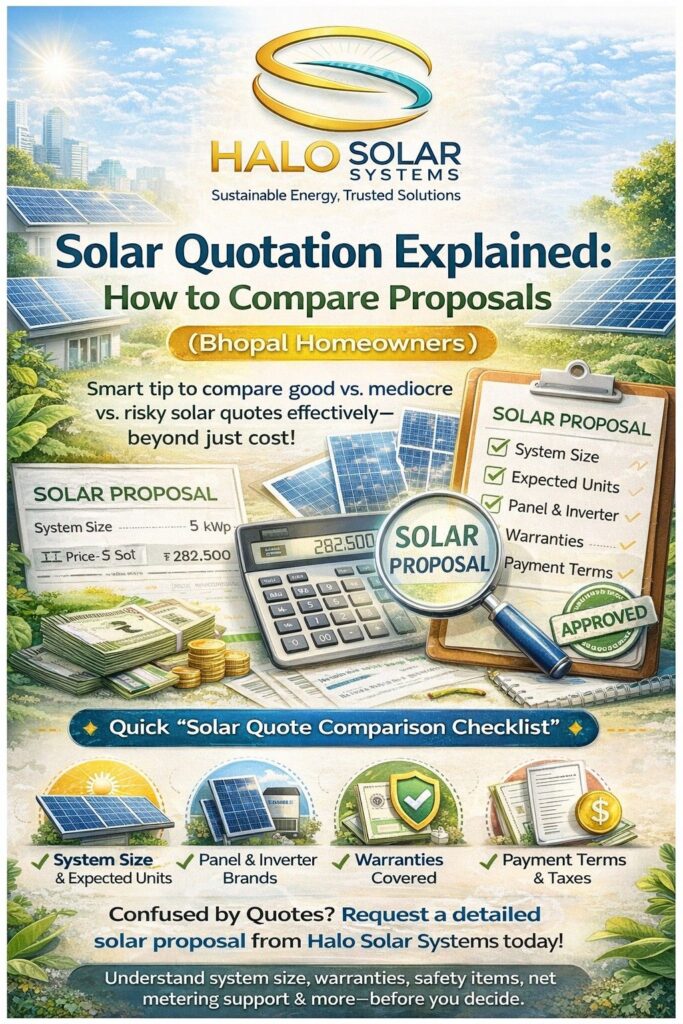
When you request 2–4 solar quotations, they often look confusing because every installer uses different wording. One quote looks “cheap,” another looks “premium,” and you’re left guessing what’s actually included. The smartest way to compare is to treat your solar quote like a full system plan—not just a price tag.
Important Note:
To get the best deal, compare total system cost, warranties, generation assumptions, and payment terms—not just the upfront price. Make sure you understand what’s included in every quote.
What a good solar quotation should clearly mention
Points:
- System size (kW) and number of panels
- Expected monthly generation (units) and assumptions
- Panel brand/model + wattage (Wp)
- Inverter brand/model + type (string/micro, single/three-phase)
- Structure type (GI/Aluminium), height, and corrosion protection
- Electrical items: ACDB/DCDB, SPD, earthing, cables, connectors
- Installation + commissioning scope
- Net metering support scope (paperwork + follow-up)
- Warranty details (panel, inverter, workmanship)
- Timeline (work days + net meter timeline estimate)
- Payment schedule and taxes
If a quote doesn’t mention these, ask for a revised “detailed BOQ” (bill of quantities).
First check: System size and expected generation (don’t skip this)
Two quotes can both say “3 kW,” but the generation numbers might be inflated in one.
Points:
- Ask: “How many units/month are you estimating for my roof?”
- Ask: “What shade assumptions did you consider?”
- Ask: “Is the estimate conservative or best-case?”
Tip: A realistic estimate builds trust. Over-promising generation usually leads to disappointment later.
Component comparison (the real quality difference)
This is where most “cheap vs expensive” differences come from.
Panels (modules)
Points:
- Brand + wattage (Wp) + technology type
- Product warranty and performance warranty
- Whether it’s Tier-1 brand (if they claim, ask proof)
Inverter
Points:
- Brand + capacity + warranty
- Efficiency and service network support
- Single-phase or three-phase match with your supply
Structure
Points:
- Material (GI/Aluminium)
- Coating/paint quality (rust protection matters)
- Wind-load design (important for long life)
Electrical safety items (must-have)
Points:
- ACDB/DCDB included or not
- SPD (surge protection device) included or not
- Proper earthing included or not
- Cable quality + routing method
If one quote is cheaper because it removed safety items, it’s not a good deal.
“Included vs excluded” is everything (ask this directly)
A clean quote should clearly show what’s included and what you’ll pay extra for later.
Ask each installer:
Points:
- Is net metering application support included?
- Is bi-directional meter cost included or paid separately?
- Are civil works included (core cutting, extra conduits, ducting)?
- Is additional wiring included if inverter is far from the meter?
- Is GST included in the final price?
If they hesitate, get it in writing.
Warranties: understand the 3 warranty types
Many people only check “panel warranty,” but solar has 3 warranties:
Points:
- Panel warranty (product + performance)
- Inverter warranty
- Workmanship/installation warranty (leakage, mounting, wiring issues)
A strong installer will give a clear workmanship warranty and service response commitment.
Don’t compare only price—compare “price per value”
Instead of “Which is cheapest?”, ask “Which gives the best long-term value?”
Compare like this:
Points:
- Total cost (including protections + net metering support)
- Warranty coverage (especially inverter + workmanship)
- Installer credibility (reviews, past installs, service team)
- Generation estimate realism
- Timeline commitment + after-sales process
Cheapest is only good if it’s complete, safe, and supported.
EMI / financing options (what to verify)
If a quote offers EMI/finance, verify the real monthly impact.
Points:
- Interest rate and tenure
- Down payment requirement
- Processing fee and hidden charges
- Pre-closure conditions
- Whether subsidy (if applicable) affects financing flow
If EMI makes sense for your cashflow, choose it. If EMI cost is too high, a slightly smaller system or phased upgrade can be smarter.
Quick “Solar Quote Comparison Checklist” (copy-paste)
Points:
- kW size + panel count mentioned clearly
- Monthly generation estimate + assumptions shared
- Panel + inverter brand/model and warranties specified
- ACDB/DCDB + SPD + earthing included
- Structure material and rust protection explained
- Net metering support scope included
- Timeline + payment schedule clearly written
- Final payable amount (with taxes) confirmed
Confused by quotes? Request a detailed and transparent solar proposal from Halo Solar Systems today—so you can compare system quality, warranties, safety items, and net metering support clearly (not just price).