

Many homeowners hear “subsidy” and assume solar becomes free. It doesn’t. Subsidy simply reduces your out-of-pocket cost—your final price still depends on the system size, component quality, roof work, safety protections, and the installer’s scope.
Under PM Surya Ghar: Muft Bijli Yojana, the Central Financial Assistance (CFA) is designed like this: 60% of system cost for up to 2 kW, and 40% of the additional system cost for 2–3 kW, with CFA capped at 3 kW. At current benchmark prices, that translates to ₹30,000 for 1 kW, ₹60,000 for 2 kW, and ₹78,000 for 3 kW (or higher, but capped at ₹78,000). (PM India)
Now let’s compare what actually changes in your final cost and experience.
1) With subsidy: what changes (and what doesn’t)
What changes
Points:
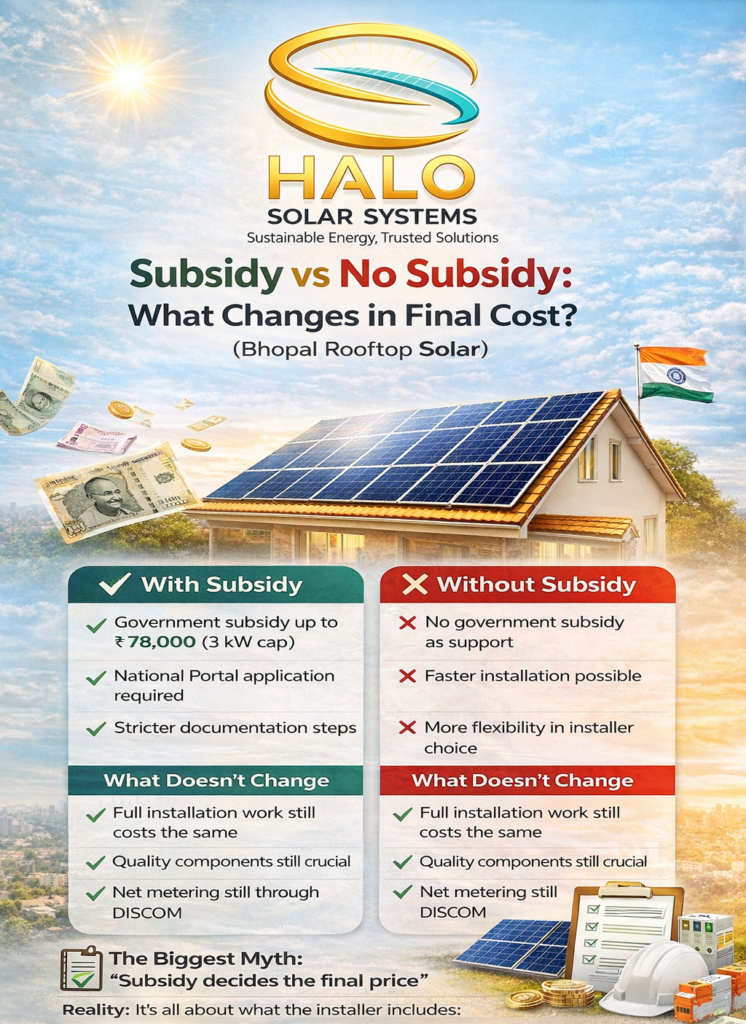
- You can receive CFA subsidy up to ₹78,000 (cap at 3 kW) based on benchmark prices. (PM India)
- The process becomes more step-based: you apply through the National Portal, and the workflow ties your vendor selection and approvals to the portal process. (PM India)
- Documentation becomes stricter (name match, bank details, portal steps, approvals).
What does NOT change
Points:
- You still pay for the full installation work (structure, wiring routes, DBs, earthing, protections, labor, commissioning).
- You still need quality components and a safe installation—subsidy doesn’t automatically mean “premium quality.”
- Your roof complexity and site conditions still affect cost (more on this below).
2) Without subsidy: what changes (and what doesn’t)
What changes
Points:
- You may be able to install faster in some cases because you’re not waiting on subsidy-linked steps and document checks.
- You may have more flexibility in choosing your installer/components (practically), though you still must meet DISCOM/grid requirements for legal grid connection and net metering.
What does NOT change
Points:
- If you want net metering, you still deal with the DISCOM process (inspection, meter replacement/bi-directional meter, commissioning).
- Safety and workmanship still matter—and these are the biggest long-term success factors.
For Bhopal, the electricity distribution area is covered by MPMKVVCL (Madhya Pradesh Madhya Kshetra Vidyut Vitaran Company Limited), which handles distribution and retail supply in the Bhopal region. (Energy Madhya Pradesh)
So net metering, inspection scheduling, and meter-related steps ultimately depend on the DISCOM process either way.
3) The biggest myth: “Subsidy decides the final price”
Reality: Subsidy is a fixed support amount (up to the cap). Your quote can still vary widely depending on what the installer includes.
Two 3 kW quotes can differ a lot because:
- One includes proper protections and a better inverter warranty
- Another removes safety items (ACDB/DCDB/SPD/earthing quality) or uses thinner wiring
- One includes strong structure work and neat cable routing
- Another uses minimal structure or poor finishing
So the right question is not “with subsidy vs without subsidy price.”
The right question is: what’s included, what quality, what warranty, and what support.
4) What really changes the price (subsidy or not)
A) Panel + inverter quality
Points:
- Brand, model, efficiency and warranty terms
- Inverter type and service support quality
- Warranty clarity (what is covered, what is excluded)
B) Roof structure and mounting complexity
Points:
- Flat roof vs sloped roof
- Height requirements (parapet, water flow, shading control)
- Additional steel/aluminium work
- Walkways/spacing for maintenance
C) Safety protections and wiring
Points:
- ACDB/DCDB, surge protection, earthing design
- Cable quality, conduit routing, weather protection
- Proper labeling and clean installation finishing
These are not “optional extras.” They protect your system and reduce downtime.
5) What you should compare in two quotes
To make a clean decision, compare two proposals in this format:
Quote A: “With subsidy plan”
Points:
- Same system size (kW)
- Same component brands/specs
- Same scope (structure, protections, wiring distance)
- Portal + documentation + inspection readiness support
Quote B: “Without subsidy plan”
Points:
- Same exact technical scope and brands
- Clear timeline
- Net metering support clarity (even if subsidy isn’t used)
If the “without subsidy” quote is cheaper only because they removed safety items, it’s not a real comparison.
6) Which one is better for you? (simple decision logic)
Choose with subsidy if:
Points:
- Your system is within the sweet spot of up to 3 kW and you want to reduce net cost
- You’re okay following the portal process and document discipline
- You want structured, scheme-aligned workflow
Choose without subsidy if:
Points:
- You want faster execution (in some cases)
- You are installing a larger capacity and the subsidy cap doesn’t change much for your total cost
- You prefer more flexibility in vendor choices
- You still plan to do net metering properly through DISCOM
Important Notes
Don’t pick the lowest quote only. Cheap installs can reduce savings (lower generation, more downtime) and create safety issues later. Subsidy reduces cost up to the capped amount (₹78,000 for 3 kW at benchmark prices), but your long-term value comes from quality components, safe installation, and reliable after-sales support. (PM India)
Want a clear cost comparison? Get two proper quotes: “with subsidy plan” vs “without subsidy plan”—with the same brands and same scope—so you can decide based on real value, not confusing price differences.
📍 Visit Us
Halo Solar Systems
Block 2, Chetak Complex, Zone 2, MP Nagar,
Bhopal, Madhya Pradesh 462011
📞 Call Us
+91 9111328840
🌞 Service Areas Across Bhopal
We proudly serve residential 🏠 and commercial 🏢 customers in:
Lalghati • Airport Road • Ayodhya Bypass • Karond • Nehru Nagar • Kotra • Neelbaad • Ratibad • Awadhpuri • Katara Hills • Baghmugalia • MP Nagar (Maharana Pratap Nagar) • Arera Colony • Habibganj • Shivaji Nagar • Char Imli • Shahpura • Kolar Road • Hoshangabad Road • TT Nagar
⚡ Clean Energy. Local Service. Trusted Support.
We’re delighted to bring reliable solar solutions across every corner of the city 🌍☀️